

Energy to the people and go to future together
파트너소개
배터리 팩/모듈 안전 검사 솔루션
배터리 팩/모듈 안전 검사 솔루션
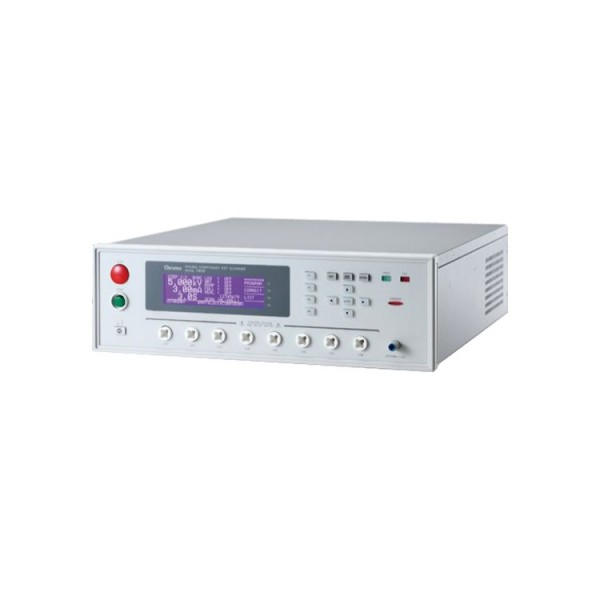
불량 컴포넌트 EST 스캐너 Model 19035 Series
Support 16CH scan box
High Speed Contact Check (HSCC)
SUB-STEP function
Open / Short Check (OSC)
GFI human protection
Flashover detection
Key lock function
RS232 Interface (standard*1)
GPIB & HANDLER (optional)
CE mark
Functions
5kVac & 6kVdc Hipot test
1MΩ~50GΩ /5kV IR test
10mΩ~500kΩ DCR test
8 channel scanner
· 제조사 : Chroma
· 원산지 : 대만
· 모델명 : 불량 컴포넌트 EST 스캐너 Model 19035 Series
제품 상세 정보
The quality verification tests for wound components consist mainly of AC/DC Hipot tests and Insulation Resistance (IR) tests. The Chroma 19035 Wound Component EST Scanner perform safety tests for motor, transformer, and heater related wound products. Reliable quality control and efficient product control are obtained when implementing this scanner for quality verification by wound component manufacturers.
Chroma's 19035 supports 5kVac/6kVdc high voltage output to conform with withstand voltage test requirements for wound components, and has a maximum output current up to 30mA. The Insulation Resistance (IR) test measurement ranges from 1MΩ to 50GΩ, and voltage output can be up to 5kV; while the DCR test can measure the resistance parameter of wound components and test the circuit connection (contact check) before the withstand voltage test.
The 19035 also has powerful functions for Flashover detection and Open/Short Check (OSC), as well as programmable voltage and time parameters for various characteristics of DUTs for increased testing reliability and product quality.
The 19035 is a comprehensive safety tester designed for motor, transformer, and heat related wound component tests. Most wound components have multiple windings, such as 3-phase motors and dual winding transformers. With 8-channel scanning ability the 19035 can measure multiple test points in one test instead of switching test points manually. This reduces test time and labor cost immensely.
The built in OSC and DCR functions verify poor contact or short circuits that occur during test, and solves the contact problems with wound components improving test quality and prolonging test equipment lifespans.
Flashover Detection

Ground Fault Interrupt (GFI)

Open / Short Check (OSC)
OSC function check for Open (bad connection) or Short (DUT short circuited) occurring during test. If a DUT has an open circuit during test, the unit might be misjudged for a good one. If a DUT has a short circuit, OSC function can filter it out to diminish the damage to the fixture and save test costs.
In general, products under Hi-pot test have capacitance (CX). CX could be tens of pF to several μF under normal conditions. When the circuit connection is interrupted, a small capacitance will be formed on the broken interface, usually lower than 10pF. This makes the entire capacitance of the product lower than the normal value. The capacitance of a product may be higher than normal when the product is short-circuited or near short circuit. Thus the high/low limit of capacitance variation can be used to identify short circuit problems.

High Speed Contact Check (HSCC)
HSCC mode is a new measurement technology for contact checks. It scans the circuit contact with multiple test points in a very short period of time. With this new feature, contact checks can be performed quickly prior to the Hipot test.
DCR Measurement 2W/4W

Temp Compensation
Problems caused by temp differences will usually occur while measuring minor DCR values, when the temp difference and the measured resistance value will be different. With the Temp Compensation function that has been added to the 19035, the DCR is converted to the measured value under standard temp via temp coefficient conversion. Thus, the measured difference generated by temp differences will be reduced.
DCR Balance
Checking DCR balance of motor windings is just as important as checking inductance balance of the windings. When the EMF drive of different windings are not matched the rotational torque force will be unbalanced causing additional shaft wobble, vibration and bearing wear which affects long term life of the motor. The DCR Balance calculates the difference between the max and min DCR of the windings and compares that value to an acceptable programmable level, which in turn gives a PASS/FAIL output result for DCR balance. The DCR Balance Test is an auxiliary test tool for motors which helps establish long-term reliability of motors.
Contact Check
DCR tests not only measure the resistance of a winding, but also check the connections before the Hipot test. Chroma 19035 can perform DCR measurement on windings to check the external contact, and specifically for capacitance lower than 20pF between the test points in a wound component.
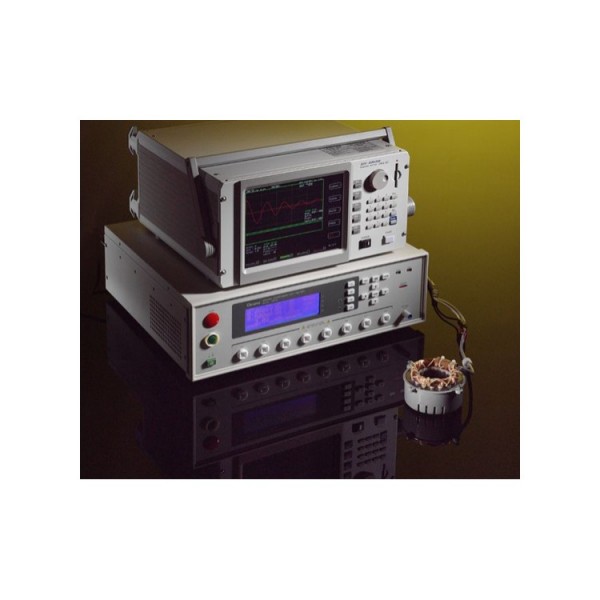
Motor/DC Fan Semi-Finished Products Electrical Testing
Motor, DC fan and other semi-finished products of electrical rotating machinery including stator and rotor require Hipot, DC resistance and layer short tests.
Sub-Step Function for Multi-UUT Testing
In order to solve the parallel test problem and reduce the number of stations and cost, the 19035 provides a Sub-Step function. The fail condition can be set as a Sub-Step activation condition by editing the program sequence when parallel testing is required for production. This means taht the Sub-Step test will be conducted only when the main test item (parallel) failed and will determine which DUT is faulty. With the implementation of this function, the efficiency of withstand voltage test is improved significantly on the production line.
Example:
STEP 1: AC Hipot / pin1 to pin5, 6, 7
Sub step A: AC Hipot / pin1 to pin5
Sub step B: AC Hipot / pin1 to pin6
Sub step C: AC Hipot / pin1 to pin7

40-Channel Scan for Wound Component Hi-pot Testing


1. Power switch
2. Unknown test terminal
3. Stop key
4. Start key
5. LCD panel
6. Function keys
7. Test key
8. Main index key
9. System key
10. Cursor keys and enter key
11. Ground terminal
12. Interlock
13. RS232 interface (standard*1, option*1)
14. Line voltage selector
15. Ground terminal
16. AC line input
17. GPIB/HANDLER/TEMP interface (optional)
18. Scan Interface
19. Return/Low (for scanner)
20. HV output (for scanner)